
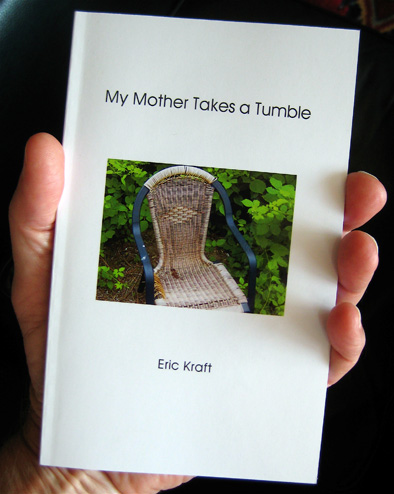
MY MOTHER TAKES A TUMBLE is included in LITTLE FOLLIES. However, it is also available on its own as a pocket-size paperback. |
||
| MY MOTHER TAKES A TUMBLE | ||
| The Babbington Press (2008) 78 pages 4.25 inches by 6.88 inches $ 10.95 |
||
| DIGITAL EDITIONS |
|
| PUBLICATION HISTORY | Apple-Wood Books, 1982
|
My Mother Takes a Tumble
Peter Leroy
Leroy explores his earliest memories, which involve Dudley Beaker, a next-door neighbor with a shady occupation; Eliza Foote, a shapely blonde (a product of his imagination); six kittens and one red wagon; and his mother’s tumble from her lawn chair.
"A good half of [My Mother Takes a Tumble] is spent on a loony romantic correspondence between a man and a woman, where each thinks the other is someone else, and each writes in the guise if the opposite sex. Somehow this oddball romance intertwines with Peter's first memory — piling a litter of kittens into his wagon — and the day his mother fell out of her lawn chair. All of these incidents, and a couple more, commingle in the logic of the child and the logic of the novelist. Shocks of recognition abound, and everything is funny as hell."
Malcolm Jones, The Bloomsbury Review
"Enterprising Mr. Beaker devises a swindle for picking up a little extra money; he places an ad, signed 'Mary Strong,' in the paper of a nearby town: 'Lovely young woman in unfortunate circumstances wishes to correspond with lonely man.' 'John Simpson' replies sympathetically, and 'Mary' bilks him with what looks like great success . . . until Jack begins harping on a certain Eliza Foote, making 'Mary' wildly jealous. It turns out that 'Jack' is Eliza Foote; the two frauds meet, fall in love, and go into business together. Only in Babbington!"
Walter Kendrick, The Village Voice
“The propensity of memory, and fiction, for revision is something the adult Peter makes much of in prefaces to the novellas, where he purports to account for oddities of narration. But what follows invariably contradicts the prefaces, and a network of additional tiny contradictions leaps out as one proceeds. The preface to ‘My Mother Takes a Tumble’ says, logically enough, that the following story concerns the significance of a day when Mrs. Leroy fell from her lawn chair. It turns out, though, that the real significance of that day is the introduction of the Leroy family to Dudley Beaker’s new sweetheart, Eliza Foote — who turns out to be the central character — and the whole story takes a tumble if you remember that Peter has asserted in the preface that Eliza Foote is the major element of fiction in the story.”
Anna Shapiro, The New Yorker
|
|
|
|
|
|
|
|
|

|

|

|
|