Peter Leroy


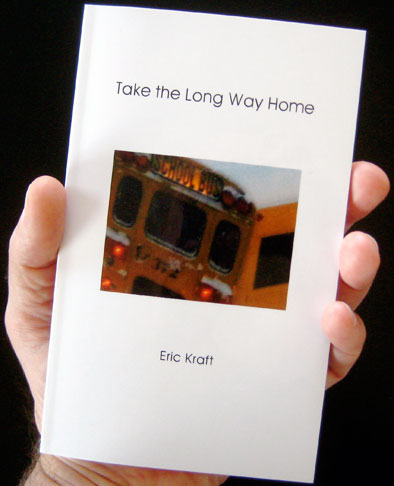
Take the Long Way Home Cover Image


TAKE THE LONG WAY HOME is included in LITTLE FOLLIES. However, it is also available on its own as a pocket-size paperback.
 

  The Babbington Press (2009)
76 pages
4.25 inches by 6.88 inches
$ 7.95

DIGITAL EDITIONS  

Kindle $1.00


Take the Long Way Home

(a sample)

THIS STORY WAS CONCEIVED at Corinne’s Fabulous Fruits of the Sea one evening when Albertine and I had dropped by for drinks and stayed for dinner. Al always knows what she’s going to have when we go to Corinne’s, and since she doesn’t eat fish, she always has the same thing: chicken. I study the menu, eliminating things one by one, remain undecided until the last minute, and then nearly always wind up ordering clams. During the important visit that led to my writing this story, we had been sitting at our table for a while, and I had eliminated everything on the menu but two things: chicken and clams.
     “Are you having chicken?” I asked Al.
     If I remember correctly, she said, “Yes.”
     “Maybe I’ll have chicken too.” I said.
     She said nothing, I think.
     “Or maybe I’ll have clams,” I said.
     She said something that I couldn’t quite make out. A waitress, Dianne, one of my favorites, arrived. Al ordered. I hesitated. Albertine said—and I’ll be forever in her debt for this—“You have to choose: chicken or clams.”
     An electrifying sensation shot through me, at once frightening and exhilarating. What Albertine had said brought back to me a memory from three decades ago, when I was in the fifth grade. My work on “Take the Long Way Home” began then. Over the intervening months, the story has grown and developed in ways that I couldn’t have predicted, but it is still possible to see that it began with the memory that Al’s statement recalled.
     Allow me a little of your time to explain what the memory was, how I changed its essentials, and why I altered them.
     When I was in the fifth grade, I competed in two memorable contests. One was a contest to name a new elementary school in Babbington. The other was a contest for the affections of Veronica McCall. I lost both.
     As I worked on “Take the Long Way Home,” I changed, among other things, the outcome of one of these contests: the name-the-school contest. In the pages that follow, I win. Why did I change the facts? To tell you the truth, I did it just to please myself. I’ve thought for nearly thirty years that I should have won that contest in the first place. Surely this is one of the motives behind any fiction: the desire to correct the errors of the past. It was easy to change the outcome, so I did.
     I would have changed the outcome of the other contest if I could have, but I couldn’t. The reasons for my losing Veronica were so deeply rooted in fact, in history, in the social fabric of Babbington, that to deny them, to try to alter them, would have meant trying to create a new social history, and since that seemed like more than I could do, I decided to stick to the facts.
     But what were the facts? These things happened to me in the fifth grade; at the time, I thought that the outcome had a simple cause: I had lost Veronica to a boy named Frankie Paretti. What did I know then about the social forces at work in Babbington? Only as I worked on the story did I come to realize that—in the largest sense—I hadn’t lost Veronica to any one boy. If I hadn’t lost her to Frankie, I would have lost her to someone else, because I really lost Veronica to the sweeping force of social change. As I worked, I kept asking myself, “How did it happen? Why was there such an upheaval in the social structure of Babbington that it produced the tsunami that swept Veronica from me?” Weeks passed before I understood that it was all the fault of Stretch Mitgang.
     It happened like this:
     Before I was born, Babbington was a stable little community, dependent on—and redolent of—the clamming industry, with some small appeal for tourists. No one living in Babbington then would have predicted that within five years a period of rapid growth would begin that would last throughout my childhood. The effects of this growth were broad and deep, both on Babbington and on me.
     Most of the reasons for Babbington’s phenomenal growth were not unique to Babbington: the population of the entire United States, indeed of the entire world, was growing rapidly in the postwar years, which these years were, and large numbers of people, especially young fertile couples, were choosing to live in places more or less like Babbington. However, the most important single reason was unique to Babbington, and that reason was Stretch Mitgang.
     Mitgang, a sociologist with psychohistorical interests, moved to Babbington just a year or so before I was born. Passing himself off as a psychosocial historiographer, Mitgang undertook a two-year study of the sexual practices of Babbingtonians. His charm and good looks made it easy for him to ingratiate himself with Babbingtonians of all stripes, so he was able to gather reams of data, thousands of anecdotes, tens of thousands of tall tales, and quite a few firsthand experiences. When he had gathered the material he needed, Mitgang disappeared. A couple of years later, he published the results of his research under the title Seafood and Sex: a Study of Life in a Coastal Town.
     In his book, Mitgang included the data, history, and logical cement that readers expected, but he also laced the book with anecdotes about Babbington and Babbingtonians that were, for their time, quite frank (and probably exaggerated), and he also included photographs that were, for their time, frank to an extreme (and probably staged). Seafood and Sex has been out of print for years, but if you take the trouble to track down a copy, you will understand why it quickly became a best-seller and why the book itself became a primary reason for Babbington’s rapid growth.
     Mitgang waxed Whitmanesque in his enthusiasm for the general good health of the citizens, the “unflagging vigor that they bring to the day’s labor and the night’s delight.” This he attributed to the generally salubrious effects of bracing salt air. He went on to praise the “mesmerizing seductiveness of its women, at once shy and bold, endearingly naive and shockingly inventive, teasing and complaisant.” These qualities he attributed to the aphrodisiac effects of moonlight on the bay. In describing the men, Mitgang returned again and again to their “sturdy thighs, priapic grandeur, and remarkable endurance,” which he attributed to the habit of hard work and to the eating of clams. That did it. As soon as the book was published, outsiders began flocking to Babbington, and the population began an accelerating rise.
     The newcomers moved into a town that was already sharply divided culturally. Clamming had always been important to the town, but after the War of 1812, for reasons too complex for me to explain here, chicken farming and processing became an important secondary industry. In the early years of this century, there occurred a series of riots during which clamdiggers attempted to drive chicken farmers out of Babbington. Most historians refer to the period during which these riots occurred as the Chicken Purge; however, the clamdiggers attacked the chicken farmers with, among other weapons, the tongs that they used for harvesting clams from the bay, and because of this unorthodox use of the clam tongs, this unpleasant period is sometimes referred to as—and I apologize for this—the Tong Wars.
     Call it what you will, it was an ugly time in Babbington’s history, one that just about everyone would rather forget. But it had such a powerful effect on the culture of Babbington that it can’t be—and, I think, must not be—forgotten. At the time, the clammies claimed that runoff from the chicken farms was fouling the bay, and there was probably some truth to the claim, but it was not the real reason for the animosity that they felt toward the chicken farmers. I think we can find the real reason if we read between the lines of a passage in Our Town and Its People, a social studies text that all fifth-grade Babbingtonians were required to study, a text commissioned by the Daughters of the Tong Wars. Of the chicken farmers that textbook said, in part:

Chicken farming is easy work, suitable for people who cannot do much else. As a group, chicken farmers are a happy-go-lucky lot. Like the birds they raise, they pass most of their lives eating, sleeping, and copulating. They live in blissful ignorance of time and tide.

I infer from this passage that the clammies were simply jealous of the chicken farmers. The chicken-farming culture seemed to offer a life that was easier, happier, and more exciting. Their own lives were hard, sometimes miserable, and often dull. But most of all, the chicken-based culture must have seemed sexy.
     Well, when Mitgang’s book appeared, it gave the clam culture reason to think of itself as far sexier than the chicken culture. One might expect that the animosity would, as a result, have disappeared, but any good psychohistorian would be quick to point out that things are rarely as simple as that. The anti-chicken attitude in Babbington might eventually have disappeared if Seafood and Sex hadn’t brought so many outsiders into the town. These newcomers, remember, had been attracted to Babbington by Mitgang’s descriptions of the clamming culture, so they arrived eager to embrace this culture, to penetrate its mysteries, to become part of it. (I’m told that it wasn’t unusual during this time to see half a dozen new Babbingtonians dogging the steps of a native, trying to learn to walk like a clamdigger ashore.) Sadly, among the aspects of clam culture embraced by the newcomers was the anti-chicken-farming prejudice.
     Now here comes the strange irony of all this, the truth-is-stranger-than-fiction part. Most of the land available in Babbington for building the houses that the newcomers would live in was in the northern half of town, away from the bay, the part of town to which the chicken farmers had been driven so long ago. This part of town had come to be known as Babbington Heights. As newcomers moved into Babbington, the chicken farms gave way to tracts of new houses, one very much like another, and most of the chicken farmers collected their money from the developers and went off to the Midwest. The people who moved into the tract houses, lured by the promise of seafood and sex, tried to emulate the Old Babbingtonians but found that the real Old Babbingtonians treated them as if they’d been born and bred in the Heights, as if they’d sprung from generations of chicken farmers.
     When my parents finally saved enough money to buy a small house, they moved from my grandparents’ house on No Bridge Road, not far from the heart of Old Babbington, to one of the small houses built on a former chicken farm in the Heights.
     Perhaps it was inevitable that the people in the Heights, stung by the rejection of the Old Babbingtonians, should band together and reject the people who rejected them. That is what they did. They turned against the old clam-based culture and developed a nostalgic affection for chicken farming, for a past and a way of life that they had never known. Like most converts, they quickly became zealots. Within a year or two, there was hardly a household in the Heights that didn’t have its small flock in a little homemade coop out in the back yard. Most people kept laying hens, but some specialized in roasters or fryers, one or two kept fighting cocks, and several had flocks of homing chickens, which they would allow to walk around the block a few times in the gathering dusk of a summer evening, summoning them home with elaborate whistle signals when night fell. I admired the ability of the whistlers, and my father became one of the best of them, but I never cared for those chickens. I was friendly with the boys and girls in my neighborhood, but my roots were in the other culture—the bay owned my heart and my imagination.

FIFTH-GRADERS are not noted for their tolerance. When the population growth forced the town to build a new central upper elementary school, and boys and girls from all over Babbington were thrown together in that new central upper elementary school, they quickly took sides, as if they were choosing up for a mammoth game of dodgeball. I had grown up with a foot in each of the cultures; I tried to remain aloof from this tribalism, but it didn’t take long for me to see that—at least for the time being—I couldn’t. I could see the way it was going to be. If I was going to have any friends in school, I was going to have to choose one camp or the other. Veronica certainly saw that this was the case, and she began to grow impatient with my reluctance to choose. Finally, on the day when the winner of the name-that-school contest was announced, just a few minutes before the announcement itself, Veronica put her ultimatum to me, in terms nearly identical to those that Albertine was to use thirty years later. She touched her hand to my cheek and said, “Peter, you’ve got to choose: chicken or clams.” I chose clams, and Veronica chose chicken, and away she went.

YOU SEE HOW DIFFICULT it would have been for me to change that outcome without changing Babbington, my past, my feelings for my family, and so on. However, all of the foregoing seemed to me far too complex to include in the story of a childhood romance.
     What to do? The solution that you’ll find in the pages that follow was not the only possible one, but working it out gave me great satisfaction. I compressed everything. Since Mitgang and Seafood and Sex were to blame for my losing Veronica, I cast Stretch Mitgang in Frankie Paretti’s role, and I used sex instead of societal forces as the reason for my losing Veronica. Then, since I really hated to see myself lose, whatever the reason, I had myself drop out of the contest instead. And finally, since my loss to Frankie Paretti still stung a bit after all these years, I cast him as an especially unattractive infant. That the satisfaction I gained from doing this to Frankie was ignoble bothered me only a little, and only for a little while.

Take the Long Way Home


Copyright © 2008 by Eric Kraft. All rights reserved. Photograph by Eric Kraft.